DRUMMOND’S ONION
ALLIUM DRUMMONDII
Onion Family, Alliaceae (formerly in the Liliaceae)
Perennial herb
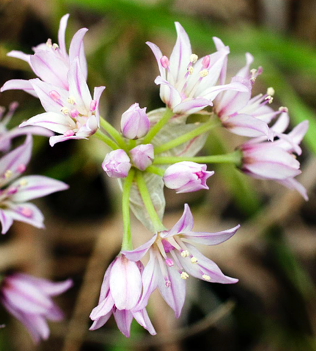
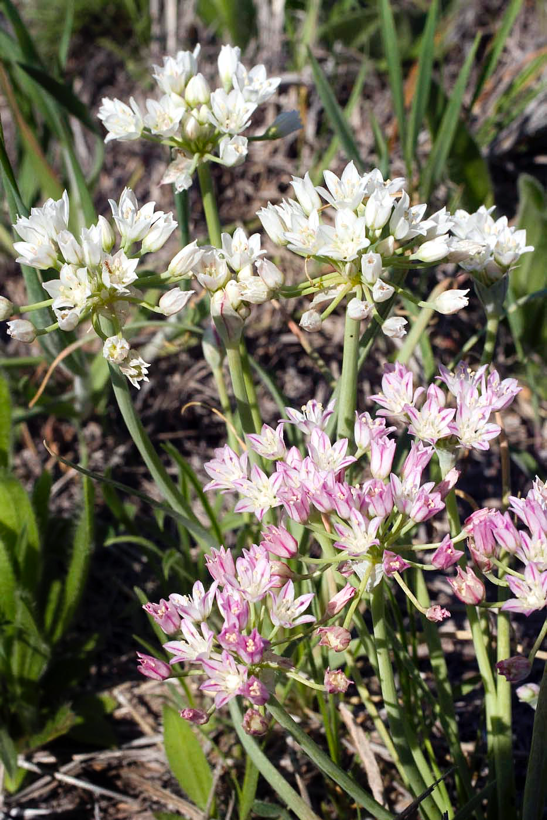
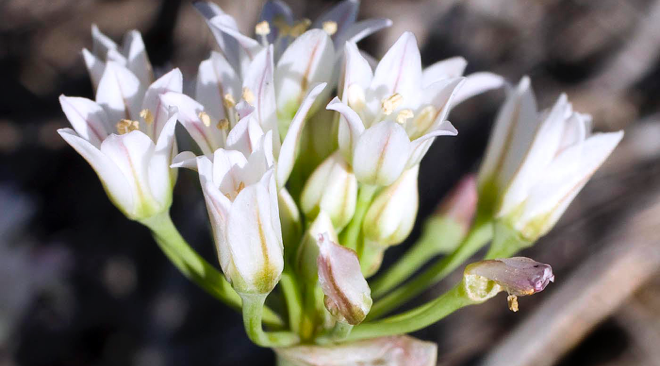
If you smell onions while hiking, you probably have stepped on this wild onion or one of its relatives. Multiple flowering stems and leaves sprout from clusters of small bulbs that are covered with fused (not net-like) fibers. Unlike other wild onions in the state with urn-shaped flowers, the white, occasionally pink, petals in this species spread open wide. Blooms in spring.
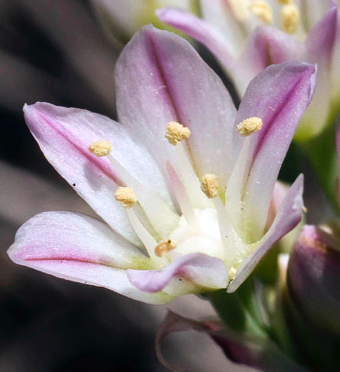
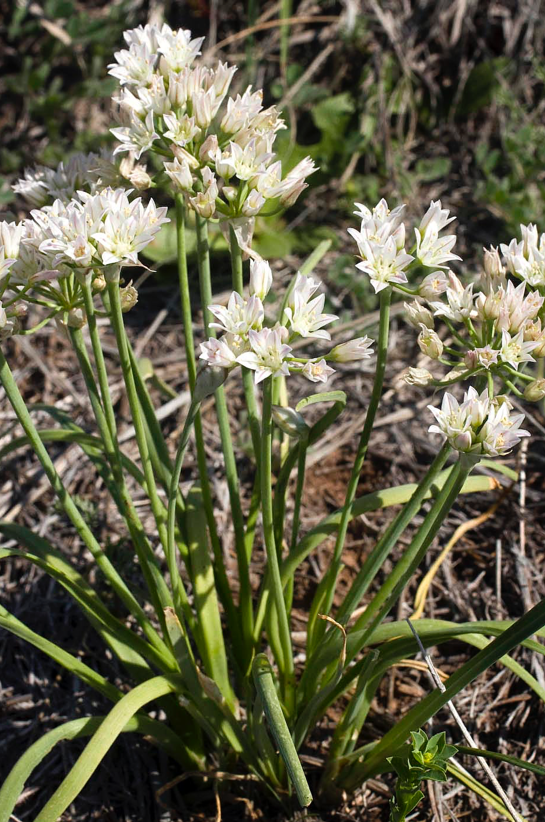
FLOWERS: March–May. After the leaves emerge in the spring, an erect 4–12-inch-tall bloom stalk (scape) sprouts with an upright, rounded cluster of 10–25 flowers on short stems. Each of the 6 white to pink or red (rarely yellow) petals has a reddish stripe down the inside middle. Flowers rarely replaced by bulbils (little bulbs). Each papery bract below the flower cluster has 1 prominent vein.
LEAVES: Basal. Clusters of 2–5 slender, 4–12 inch long, grass-like leaves emerge from a clump of 1–5 bulbs in the spring. Blades are about as long as the flower stem, solid, flat, and slightly cupped to form a shallow channel.
HABITAT: Sandy, gravelly, calcareous soils; desert grasslands and scrub, piñon-juniper woodlands.
ELEVATION: 3,200–6,300 feet.
RANGE: AR, KS, NE, NM, OK, TX.
SIMILAR SPECIES: Large-petaled Wild Onion, A. macropetalum, nearly statewide in arid habitats, has leaves longer than the flower stem, bell-shaped flowers with red-striped petals and bracts below the flower cluster with 2–5 prominent veins (use lens). Alliumspecies are variously placed in the Amaryllis family, Amaryllidaceae, or the newly-designated Onion family.
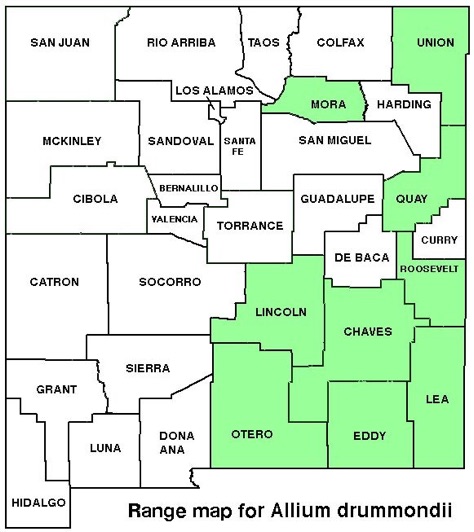
NM COUNTIES: Common in eastern plains and SE NM in low-elevation, arid habitats: Chavez, Eddy, Lea, Lincoln, Mora, Otero, Quay, Roosevelt, Union.