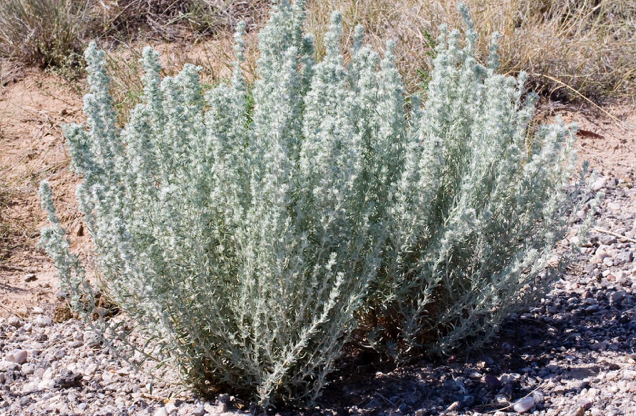
WINTERFAT
KRASCHENINNIKOVIA LANATA
Amaranth Family, Amaranthaceae (formerly in the Chenopodiaceae)
Perennial, semi-shrub
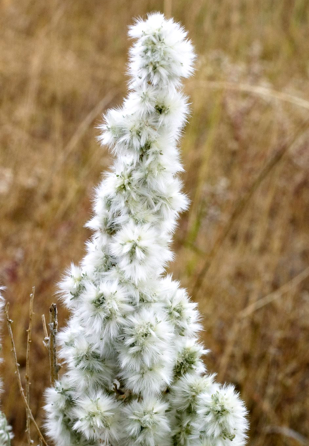
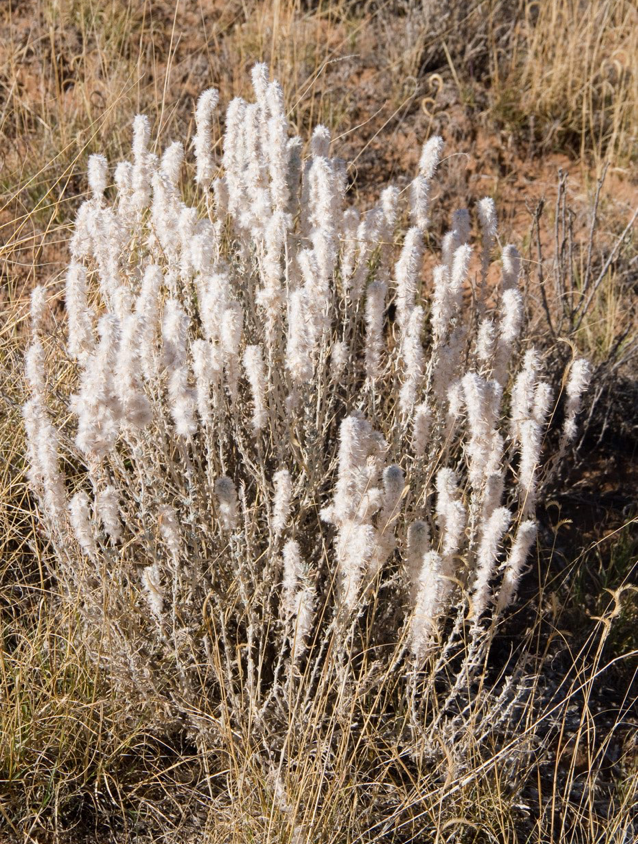
In the fall, the 20-inch-tall, erect, woolly-hairy stems branching from a woody base look like wads of cotton. A dense spike of fluffy, hairy seeds covers the branch ends. Note the densely hairy-woolly stems and foliage give the plant a gray-green appearance. The long-lived (120+ years) plant can have a 6-foot-deep taproot and is a nutritional winter forage for livestock, hence the common name.
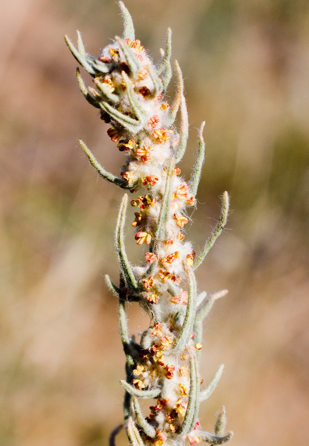
FLOWERS: May–July. Inconspicuous male and female flowers are separate on 1–7 inch long spikes with the numerous male flowers deciduous after blooming; 1–4 female flowers in axils with densely hairy bracts, no petals. Showy seed heads on female flowers only.
LEAVES: Alternate. Blades narrow, linear to lance-shaped, 3/8–1 1/4 inches long (1–3 cm), margins curled under, surfaces densely white-woolly hairy with prominent midrib.
LEAVES: Alternate. Blades narrow, linear to lance-shaped, 3/8–1 1/4 inches long (1–3 cm), margins curled under, surfaces densely white-woolly hairy with prominent midrib.
ELEVATION: 3,500-9,500 feet.
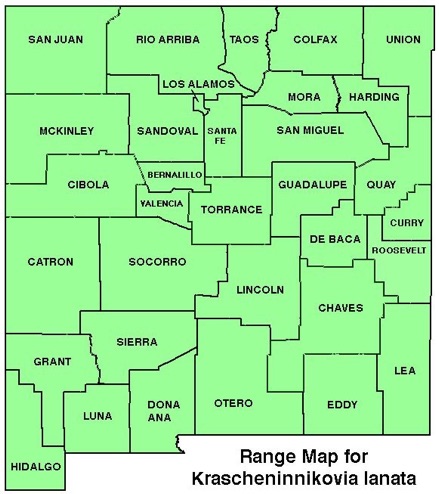
RANGE: Throughout the intermountain Rocky Mountain states and westward.
SIMILAR SPECIES: Numerous chenopods and pigweeds in NM, but the dense spike of fluffy seeds distinguish Winterfat.
NM COUNTIES: Statewide in mid- to high-elevation, dry habitats.