PARISH’S BISCUITROOT, NEVADA BISCUITROOT
LOMATIUM NEVADENSE
Parsley Family, Apiaceae
Perennial herb
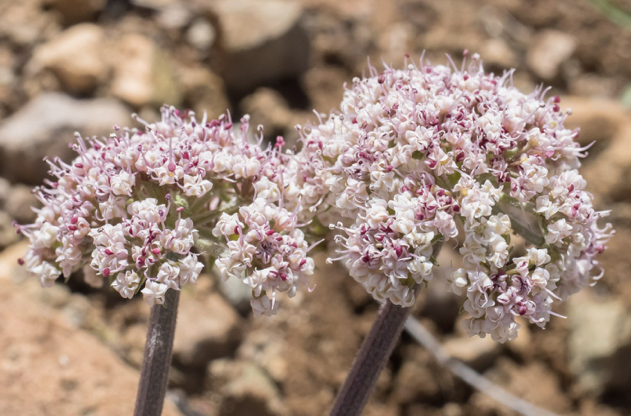
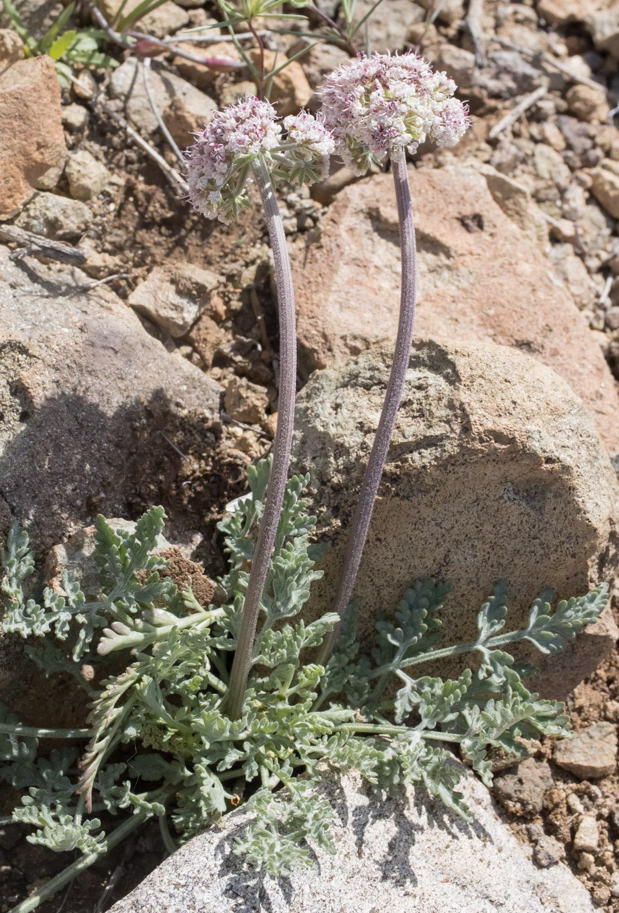
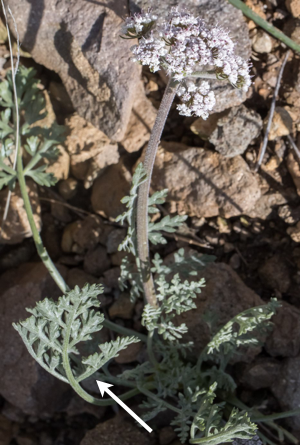
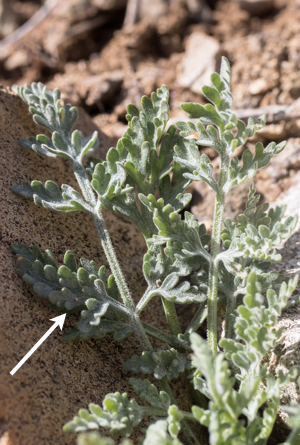
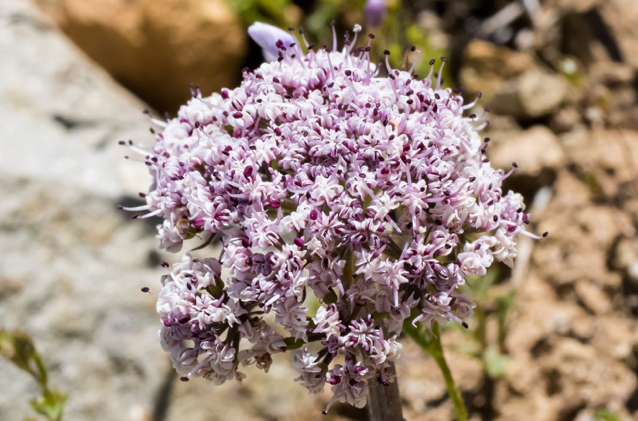
Hairy, leafless flower stems grow from a basal cluster of finely-hairy, gray-green, parsley-like compound leaves. The leaflets are arranged opposite along the midrib and deeply-incised into pointed lobes. Each stem is topped with a densely-clustered, round-topped array of small white to cream-colored flowers. Note the gray-green, hairy parsley-like leaves, and the showy cluster of flowers. The common name comes from the long taproot with a round, biscuit-like tip traditionally eaten like a radish. Also called Parish’s Springparsley.
FLOWER: February–April. Small white to creamy flowers densely packed in rounded, umbrella-like clusters (umbels); red anthers extend beyond the petals; flower stem is leafless, finely hairy, 2–18 inches tall (5–45 cm). Fruit is an oblong, angled capsule, 1/4–3/8 inch long (6–8 mm), hairy or not according to variety.
LEAVES: Basal cluster of 3–4 leaves on 2 inch (25 mm) stems (petioles). Blades greenish-gray, 1 1/2–4 inches long (4–10 cm), parsley-like, dissected 2–3 times into opposite pairs of leaflets; surfaces covered with fine, white, woolly hairs.
HABITAT: Dry sandy, gravelly, rocky soils; slopes, mesas, foothills; desert grasslands and scrub.
ELEVATION: 3,000–7,500 feet.
RANGE: AZ, CA, NM, NV, OR, UT, WA, ID.
SIMILAR SPECIES: Two poorly defined varieties: var. parishii (in NM) has hairless seeds; var. nevadense (not reported in NM) has hairy seeds. Fendler’s Springparsley, Cymopterus glomeratus, in the northern half of NM and scattered in the south, has shiny leaves and yellow flowers.
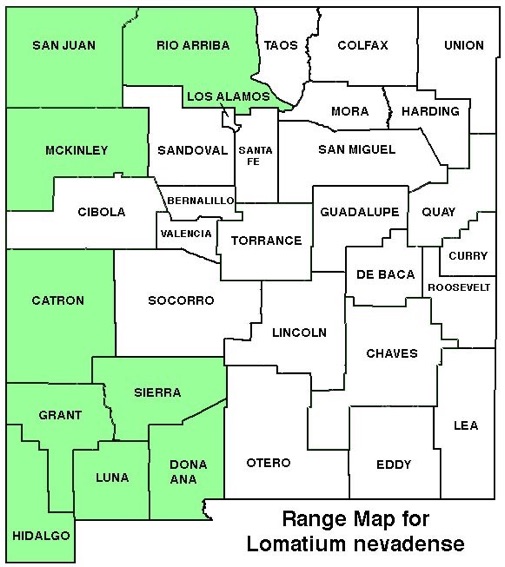
NM COUNTIES: Southern and western NM in low- to mid-elevation, dry habitats: Catron, Doña Ana, Grant, Hidalgo, Luna, McKinley, Rio Arriba, San Juan, Sierra.